
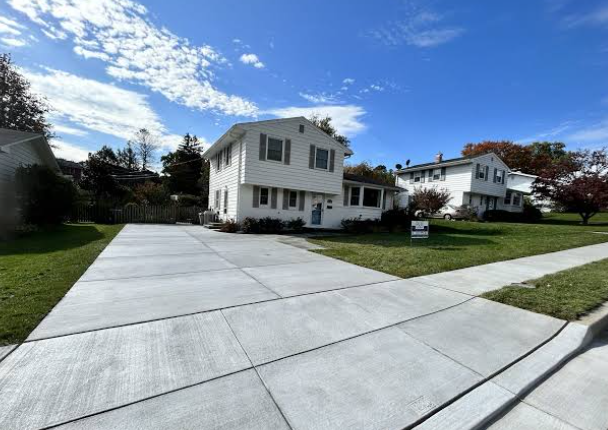

Large patios face more movement than smaller slabs because heat, moisture, soil pressure, and curing shrinkage affect a wider surface. Experienced concrete companies plan for that movement instead of assuming concrete will remain completely still. Careful preparation, reinforcement, joint placement, and curing help keep normal cracking controlled and less noticeable.
Sawing Control Joints at Precise Depths to Guide Natural Shrinkage
Fresh concrete loses volume as excess moisture leaves the mix, creating internal tension throughout the slab. Properly placed control joints form planned weak points where shrinkage cracks can develop in straight, organized lines rather than spreading randomly across the patio. Skilled concrete contractors determine joint spacing from slab thickness, patio shape, corners, columns, and narrow sections.
Timing also affects how well each cut performs. Crews must saw early enough to guide the developing crack but late enough to avoid tearing soft concrete along the edges. Qualified concrete contractors in Huntsville AL usually cut joints to about one-quarter of the slab depth, giving stress a clear path without weakening the entire section.
Compacting a Thick Gravel Base to Prevent Uneven Settling Underneath
Stable patios depend on consistent support below the concrete. Loose soil, soft pockets, buried roots, or poorly compacted fill can cause separate areas to sink at different rates. Reliable cement contractors remove weak material and install a gravel base that spreads loads while allowing water to move away from the slab.
Layered compaction produces better results than placing all the stone at once. Heavy equipment presses each lift into a dense, even foundation before the next layer goes down. Homeowners searching for concrete companies near me should ask how crews verify base thickness and compaction, since surface repairs cannot permanently correct a patio resting on unstable ground.
Laying a Steel Rebar Grid or Wire Mesh to Bind the Concrete Together
Reinforcement does not guarantee a crack-free slab, but it helps hold cracked sections together and limits vertical separation. Steel rebar provides strong support across wide patios, especially where furniture, outdoor kitchens, fireplaces, or other heavy features add concentrated loads. Wire mesh may suit lighter applications when contractors position it correctly within the slab.
Correct placement matters more than simply including steel in the estimate. Reinforcement left on the gravel cannot support the concrete above it, so crews use chairs or supports to keep it at the designed height. Established concrete companies in Huntsville AL also maintain proper spacing and overlap to prevent weak areas between sections.
Mixing Structural Fibers into the Concrete to Stop Micro-cracking
Tiny fibers spread through the mix and help control small cracks while the concrete remains young. These materials reduce plastic shrinkage, which often develops near the surface when evaporation happens faster than moisture can rise from inside the slab. Professional cement contractors in Huntsville AL may use synthetic or structural fibers depending on the patio design.
Several benefits make fiber reinforcement useful for broad outdoor slabs:
- Fibers distribute support throughout the full concrete mixture.
- Early surface cracks tend to remain smaller and tighter.
- Corners and irregular shapes gain added internal resistance.
- Finished areas become less vulnerable during rapid moisture loss.
- Reinforcement works across spaces between rebar or mesh lines.
Unlike steel, fibers do not replace every form of structural reinforcement. Knowledgeable concrete contractors near me combine them with sound base preparation, proper joints, and controlled curing rather than treating one additive as a complete solution.
Mist-curing or Sealing the Slab to Prevent Rapid Surface Drying
Rapid drying can leave the patio surface shrinking faster than the concrete underneath. Hot weather, direct sunlight, low humidity, and wind increase moisture loss during the first hours after finishing. Capable concrete contractors use misting, wet coverings, curing compounds, or sealers to slow evaporation and promote more even strength development.
Consistent curing also improves surface durability. Concrete that retains moisture long enough can form a denser cement structure with better resistance to dusting, scaling, and wear. Anyone comparing cement contractors near me should ask what curing method will be used and how long foot traffic, furniture, or heavy objects must stay off the slab.
Placing Thick Expansion Joints Where the Slab Meets Walls or Steps
Patios expand as temperatures rise and contract as conditions cool. Expansion joints create a flexible separation between the slab and fixed structures such as foundations, steps, columns, retaining walls, and pool decks. Without that space, growing concrete can press against rigid surfaces and chip edges or force cracks inward.
Compressible joint material must extend through the slab’s full depth to allow independent movement. Trusted concrete contractors near me position these joints before placement and keep wet concrete from bridging across them. This detail becomes especially important on large patios connected to several structures that respond differently to seasonal temperature changes.
Keeping the Mix Ratio Tight to Limit Volume Loss As the Slab Cures
Excess water makes concrete easier to place, but it also increases shrinkage as that moisture evaporates. A controlled water-to-cement ratio produces stronger concrete with fewer internal voids and less volume loss during curing. Reputable concrete contractors avoid adding unnecessary water at the job site simply to make finishing faster.
Workability can be improved with approved admixtures rather than diluting the mixture. Experienced cement contractors also coordinate delivery times, crew size, placement sequence, and weather conditions so concrete reaches the forms at the proper consistency. Property owners looking for concrete repair near me often find that widespread cracking began with a weak mix or poor placement practices. Legacy Outdoor Services can coordinate patio excavation, base installation, reinforcement, joint layout, concrete placement, and curing as part of a complete outdoor construction plan.