

A contractor installing foundations for a timber terrace faces a very different task from a team preparing hundreds of support points for a commercial structure. Both projects may use ground screws, yet the machinery required to install them can vary considerably. Ground conditions, pile dimensions, available working space and the number of installations all influence equipment selection. Choosing a ground screw driver without considering these factors can create unnecessary costs, slow construction or prevent work from being completed as specified.
Hydraulic installation equipment offers several ways to meet these requirements, from compact handheld devices to dedicated tracked machines. The range of designs illustrated at https://iron-mechanics.com/product-category/ground-screw-drivers/ demonstrates how different equipment configurations can serve different construction needs. Understanding their operating principles helps contractors distinguish between machinery intended for occasional installations and equipment suited to demanding professional workloads.
The central question is not which ground screw driver offers the highest advertised torque. It is whether the machine can install the required foundations safely, accurately and efficiently under the conditions expected on site. A suitable choice must balance mechanical performance with accessibility, positioning capabilities and operating costs.
How Ground Screw Installation Equipment Works
Ground screws are steel foundation elements that enter the soil through rotation rather than conventional excavation and concrete placement. Depending on their design, they may support lightweight structures, fencing, decking, garden buildings or more substantial engineered foundations. Their suitability depends on structural loads, ground characteristics, corrosion requirements and the specifications of the particular foundation system.
Installing a ground screw requires sufficient rotational force to overcome resistance between the steel element and the surrounding soil. The equipment must also maintain the intended alignment while the screw advances. Installation becomes more difficult when dense soil layers, stones or other obstructions interfere with penetration. A machine must therefore provide adequate torque without sacrificing the control necessary for proper positioning.
Hydraulic ground screw drivers use pressurised fluid to power a motor that rotates the installation shaft. The available torque depends on the hydraulic motor, pressure, gearing and mechanical efficiency, while fluid flow influences rotational speed. These characteristics must be considered together because a high maximum torque rating does not necessarily indicate how rapidly a machine will complete a particular installation.
The equipment also needs a suitable arrangement for handling reaction torque. As the motor rotates a ground screw in one direction, an opposing force acts on the machine. This force must be safely resisted through an appropriate structure, carrier or restraint system. Failure to account for reaction forces can make installation unstable and expose operators to serious hazards.
Different driver designs solve these mechanical and operational problems in different ways. Some prioritise portability, while others provide integrated positioning systems or make use of existing construction machinery. Understanding these distinctions is more useful than comparing equipment solely by its physical size.
Handheld Drivers for Smaller Construction Tasks
Handheld hydraulic ground screw drivers can be useful when larger machines cannot easily reach the installation area. Residential gardens, narrow passages and sites with established landscaping may offer little room for an excavator or tracked installation machine. Compact equipment can reduce the logistical difficulties associated with bringing heavy machinery onto such properties.
A typical application might involve installing ground screws for a small deck, fence or garden structure. These projects often require a limited number of foundation points, making the mobilisation of larger machinery less economical. The compact nature of handheld equipment may also allow workers to operate closer to existing features, provided sufficient clearances and suitable reaction-torque arrangements are maintained.
The Falcon handheld helical pile driver is an example of equipment developed for this category of installation. Its configuration reflects the need for a portable hydraulic drive rather than a complete self-propelled machine. However, portability should not be confused with unlimited operating capability. Contractors must verify the driver’s torque capacity, hydraulic requirements and compatibility with the intended screw dimensions.
Handheld equipment may require a separate hydraulic power source and suitable supporting arrangements. This means the complete installation system can occupy more space than the drive unit itself suggests. Operators must also account for handling loads, control arrangements and the physical effort involved in positioning the equipment.
The limitations become more apparent as pile dimensions and installation resistance increase. Larger ground screws may require torque levels or reaction-force arrangements beyond the practical capabilities of a handheld installation system. Repeated installations across a substantial site can also make manual repositioning inefficient.
For smaller projects, the strongest argument for handheld equipment is often accessibility rather than maximum productivity. When selected within its operating limits, a portable driver can provide a practical alternative to machinery that would be difficult to transport or position on site.
Excavator Attachments and Independent Drive Heads
Contractors who already own suitable excavators may prefer a hydraulic ground screw driver attachment. Instead of purchasing a separate installation machine, they can use the excavator’s hydraulic system and boom to power and position a compatible drive unit. This approach can be particularly attractive when screw pile installation forms only one part of a broader construction operation.
The Claw helical pile driver for excavators represents this type of equipment. Its installation arrangement relies on a suitable carrier machine, which provides positioning capabilities and hydraulic power. The operator can potentially work across several foundation locations within the excavator’s operating reach. However, the attachment must be compatible with the carrier’s hydraulic specifications, mounting system and safe working limits.
Independent hydraulic drive heads offer another configuration. Equipment such as the Lynx drive head can form part of a compatible hydraulic installation arrangement, allowing contractors to select a suitable carrier or support system for their requirements. This flexibility can be valuable for specialist applications, although integration demands careful technical assessment.
Before purchasing an attachment or independent drive head, contractors should examine several factors.
- Hydraulic compatibility. The carrier must provide the pressure and flow required by the drive unit without exceeding either machine’s operating limits.
- Torque and pile dimensions. The selected equipment must be suitable for the anticipated installation resistance and the specified ground screws.
- Mounting arrangements. Connections, adapters and support structures must be compatible with the drive unit and intended carrier.
- Working geometry. The equipment must provide sufficient reach and control to position piles accurately throughout the installation.
- Operator safety. The complete arrangement must safely manage reaction forces, suspended loads and other hazards associated with rotating equipment.
One advantage of excavator-mounted systems is their potential to reduce the number of specialised machines required on site. An excavator may complete other operations before or after the foundation installation, improving the utilisation of existing equipment. However, this benefit depends on the construction programme and whether the carrier is available when needed.
Independent drive heads can also offer opportunities for equipment integration, but contractors should avoid improvised installations without appropriate engineering verification. Hydraulic power alone is insufficient if the mounting structure, positioning arrangement or reaction-torque restraint is unsuitable.
The financial appeal of these systems is strongest when the contractor can make consistent use of existing compatible machinery. Where an excavator must be hired exclusively to operate the pile driver, the total cost should be compared with other installation methods.
When Self-Propelled Tracked Equipment Makes Sense
Large projects introduce operational demands that may be less significant during occasional residential installations. Moving between foundation positions, handling piles and maintaining installation accuracy can consume considerable working time. A machine designed specifically for repetitive installation work may provide advantages over systems that require frequent manual handling or repositioning.
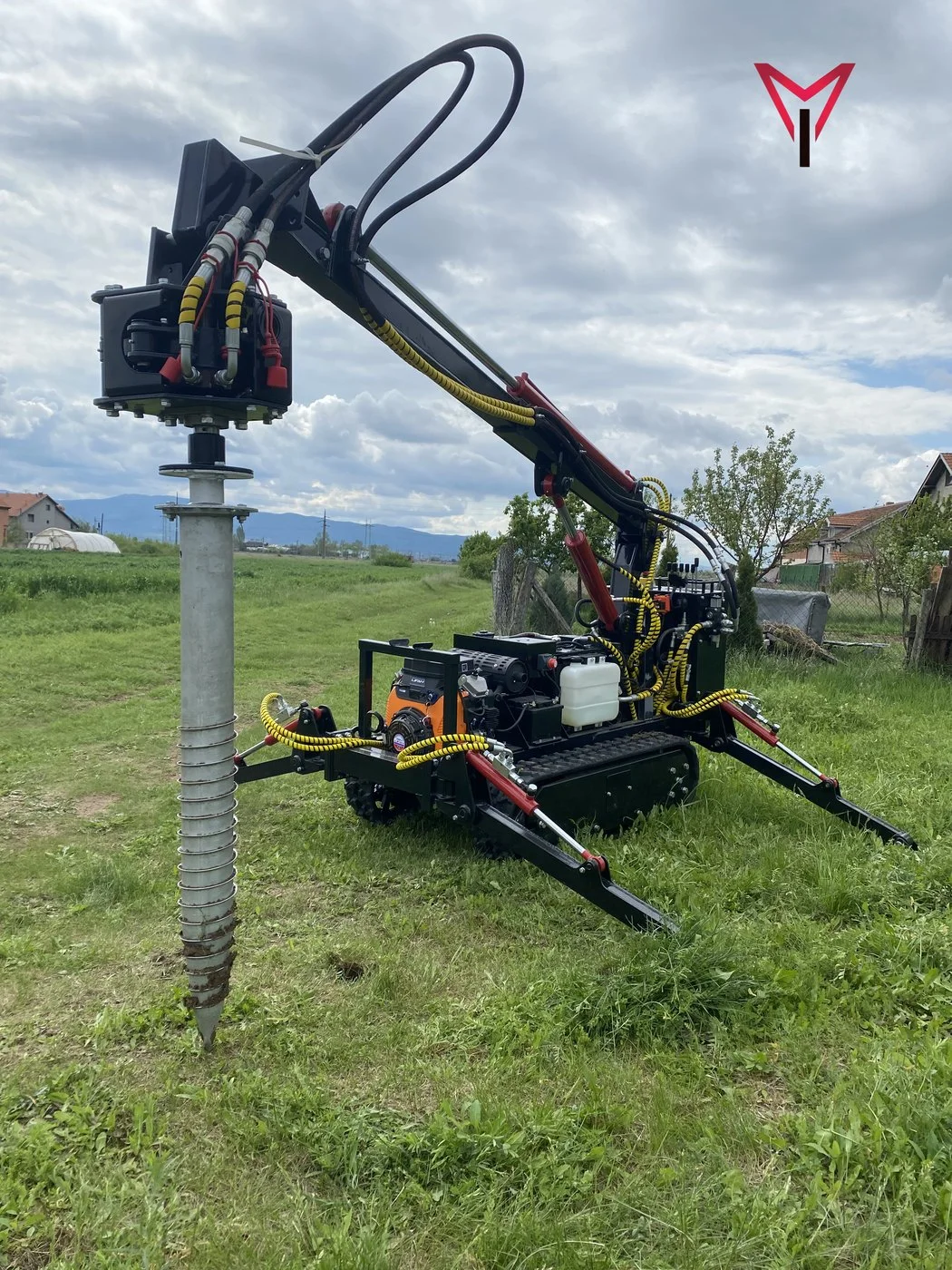
The Cougar helical pile machine is an example of a self-propelled tracked installation system. Its design combines a tracked chassis with hydraulic installation equipment, allowing the machine to move between working positions under its own power. A telescopic boom and adjustable drive arrangement assist with positioning the installation tool. This configuration is intended to bring mobility and pile installation functions together in a dedicated machine.
Tracked movement can be useful on construction sites where the surface is uneven or where installation points are distributed across a relatively large area. The machine can travel between positions without requiring a separate carrier for each movement. Nevertheless, tracks do not make equipment suitable for every surface. Ground bearing capacity, slopes, obstacles and operating clearances still require assessment.
The practical benefits depend heavily on the number and distribution of piles. Installing a small number of ground screws may not justify the transport and mobilisation costs of a dedicated tracked machine. Projects involving repeated installations, particularly where efficient positioning is important, may offer a more favourable operating case.
A self-propelled machine also introduces additional maintenance responsibilities. Tracks, engine components, hydraulic systems and moving assemblies all require inspection and servicing. Contractors must consider transport arrangements, storage requirements and operator training alongside the initial purchase price.
Productivity should be evaluated across the complete installation cycle rather than by rotation speed alone. The time needed to approach a foundation position, align the drive, install the pile, perform checks and move to the next location determines the working rate. A dedicated tracked installation system may reduce some of these operations, but actual performance remains dependent on project conditions.
Matching Equipment to Ground Conditions and Workload
Ground screw driver selection begins with the foundation design and available ground information. A machine must have sufficient capacity to install the specified pile, but the required torque cannot be established reliably from shaft diameter alone. Helix geometry, soil properties, installation depth and potential obstructions all influence the resistance encountered during installation.
Contractors should also distinguish between installing relatively small ground screws and larger engineered helical piles. Although the installation principles are similar, structural requirements and operating loads can differ substantially. Equipment suitable for lightweight garden foundations may not be appropriate for piles supporting buildings or other heavily loaded structures.
An organised selection process can help prevent unsuitable purchases.
- Establish the foundation requirements. Confirm pile dimensions, installation depth, alignment tolerances and the engineering specifications governing the work.
- Assess the ground conditions. Review available geotechnical information and identify possible obstructions or soil layers that could increase installation resistance.
- Evaluate site access. Measure available clearances, establish suitable machinery routes and identify restrictions affecting equipment positioning.
- Compare complete installation systems. Consider hydraulic power, torque, drive compatibility, reaction-force management and the equipment needed to handle piles.
- Estimate project utilisation. Calculate the expected number of installations, repositioning requirements and the likely frequency of future work.
- Review operating costs and support. Include maintenance, transport, replacement parts, training and equipment availability in the financial assessment.
The results may favour different equipment categories for different projects. A handheld driver might be appropriate for a limited number of installations on a confined property, while an excavator attachment could make better use of machinery already available to the contractor. A tracked machine may become attractive when repeated installations justify a dedicated system.
The installation method should also reflect the site’s environmental and structural constraints. Working near existing buildings, buried utilities or sensitive landscaping may require additional precautions and specialised procedures. Equipment dimensions and manoeuvrability must be considered together with the possibility of ground disturbance.
Contractors should request complete technical documentation before making a final decision. Manufacturers’ specifications can establish the machine’s rated capabilities, but demonstrations and evidence from comparable projects can provide useful additional context. Engineering requirements and the equipment manufacturer’s operating limits should govern the final selection.
Equipment Choice and Long-Term Business Performance
Ground screw drivers represent an investment in both machinery and the way a construction business organises its projects. Equipment that is inexpensive to purchase may prove costly if it requires excessive labour, frequent maintenance or additional machinery to complete routine installations. Conversely, a more sophisticated machine may be difficult to justify if it remains unused for much of the year.
Ownership costs should be considered alongside project profitability. Fuel, transport, hydraulic maintenance, insurance and replacement components contribute to the true cost of operating installation equipment. For contractors completing only occasional screw pile foundations, hiring or subcontracting may offer greater flexibility than permanent ownership.
Businesses undertaking regular foundation work have different priorities. Consistent machine availability, predictable installation procedures and efficient movement between working positions can influence their capacity to accept contracts. The ability to handle a range of pile specifications may also be valuable, provided the equipment remains suitable for the ground conditions encountered.
No single ground screw driver configuration is ideal for every construction project. Handheld systems, excavator attachments, independent drive heads and self-propelled machines each address different combinations of access, mechanical performance and operational workload. Their relative advantages become clear only when assessed against specific installation requirements.
The most productive equipment is not necessarily the largest, fastest or most powerful machine available. It is the system that can complete the required foundations safely, achieve the specified installation parameters and operate at a sustainable cost. Contractors who evaluate these factors before investing are better positioned to avoid unnecessary expenditure and maintain reliable construction performance.